
Battery cell simulation and BMS validation
Battery Emulator for BMS Testing
Simulate battery cells, pack voltage, sensor signals, and safety test conditions before moving to real battery packs.
Application experience across humanoid robotics, EV manufacturing, and large battery programs.
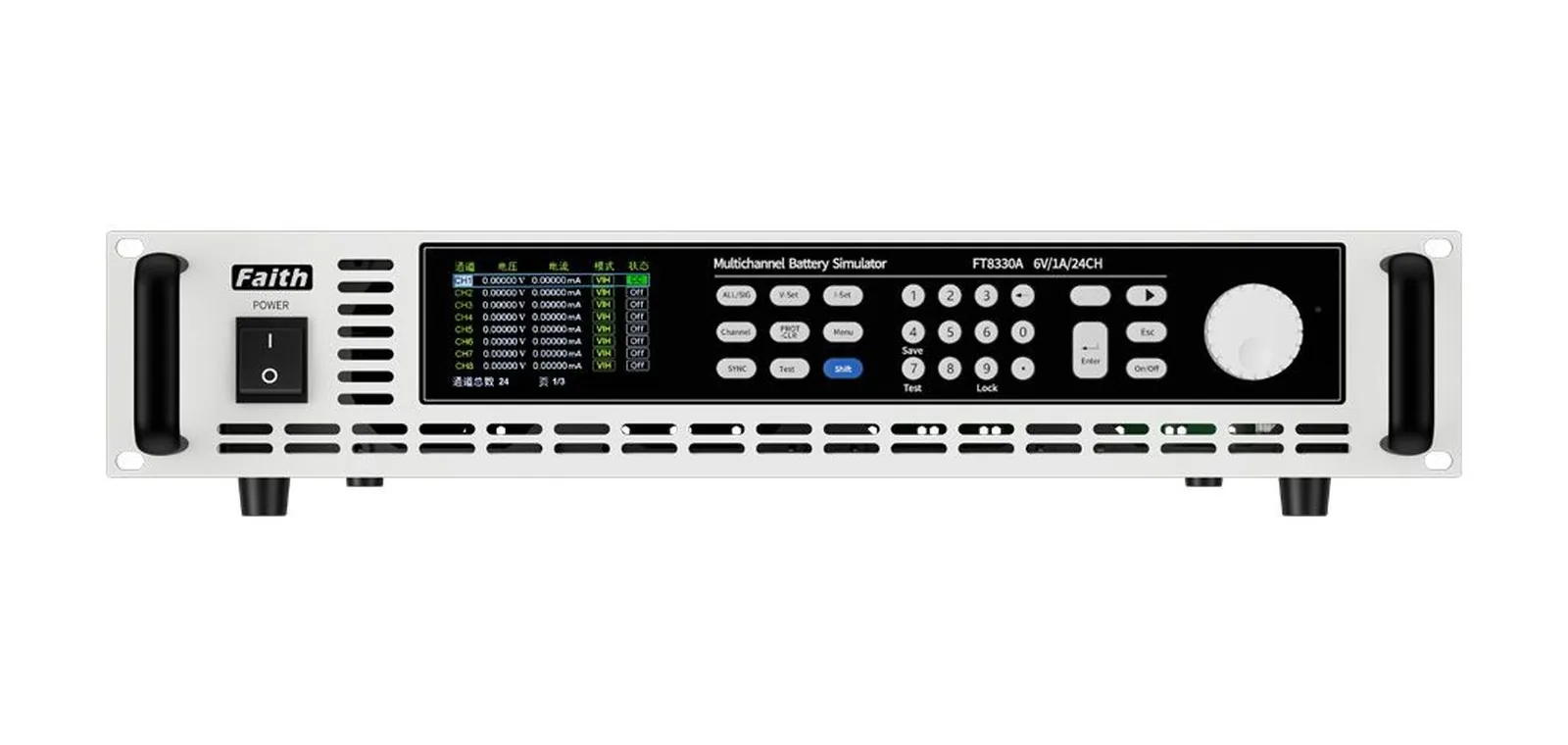
Cell simulation
Fault scenarios
BMS benches
- Early BMS checks
- Validate sensing, balancing, communication, and protection logic sooner.
- Repeatable faults
- Reproduce open, short, reverse, and imbalance conditions without pack risk.
- System handoff
- Move from cell emulation to complete FaithTech BMS and safety test setups.
Plain-language guide
What Is a Battery Emulator?
A battery emulator lets engineers test electronics as if a real battery cell or pack were connected. Instead of waiting for charged packs, managing risky fault cases, or repeating manual setup steps, the test bench can reproduce controlled voltage, current, and fault behavior on demand.
For BMS teams, that means faster validation of cell monitoring, active or passive balancing, protection logic, pack sensing, and communication behavior. Real battery testing still matters, but an emulator makes the early and repeatable work safer and easier to control.
FaithTech technical snapshot
Battery Simulator Series at a Glance
Use this summary to shortlist the right FaithTech platform before asking for a detailed configuration.
1-36+ channels
6V, 15V, 20V and +/- options
Compare specs and contact FaithTech
Up to
36CH
cell simulation
Voltage accuracy
0.01% F.S.
class options
Current resolution
0.1uA
for standby tests
Complete validation
BMS
cell, pack, sensor, I/O
| Series | Best fit | Channels | Voltage | Current | Key capability | Recommended when |
|---|---|---|---|---|---|---|
| FT8330 | High-channel battery cell simulation | 12-36CH | 0-6V | 0-3A | 0.01% + 0.01% F.S. voltage accuracy, 0.1mV / 0.1uA resolution, isolated channels. | You need dense cell-string simulation for BMS or production-line validation. |
| FT8331 | Precision single-quadrant simulator | 12-24CH | 6V / 15V / 20V | 1A / 2A / 3A / 5A | 0.01% F.S. voltage accuracy, uA-level static power testing, optional Series A fault simulation. | You need higher voltage options with fault and standby-current testing. |
| FT8340 | Bidirectional high-current simulator | 4-12CH | +/-5V to +/-20V | +/-1A to +/-10A | Source/load switching, DVM option, fault simulation option, active and passive balancing support. | You need charge/discharge behavior or higher balancing current in a compact rack unit. |
| FT8350 | High-channel bidirectional BMS testing | 16-24CH | 6V / 15V / 20V | +/-1A / +/-2A / +/-3A / +/-5A | 0.01% F.S. voltage accuracy, 3U/24CH integration, fault simulation option, active/passive balancing. | You need multi-channel bidirectional simulation for a fuller BMS test bench. |
| FT9350 | Comprehensive BMS signal and fault simulation | Up to 39 isolated channels plus 36 NTC channels | Cell and pack signals | µA-level measurement | Cell, temperature, total voltage/current, and fault simulation in a modular 4U platform. | You need one integrated platform for BMS input and protection validation. |
| FTS8500 | Real battery safety validation | System | Battery-level | Forced charge / discharge | Voltage, current, and temperature control with curves, protection, and report export. | You need UN 38.3, IEC 62133, or GB 31241 forced charge/discharge testing. |
Choose the right test tool
Battery Emulator vs Battery Simulator vs Battery Cycler
| Tool | Main use | Typical test object | BMS fit | FaithTech path |
|---|---|---|---|---|
| Battery emulator | Controlled cell or pack behavior, faults, and repeatable scenarios. | BMS boards, protection boards, pack controllers. | Best for early validation and controlled fault checks. | FT8330 / FT8331 / FT8340 / FT8350 / FT9350 |
| Battery simulator | Programmable battery-like source for voltage, SOC, and transient tests. | Electronics that need stable battery behavior. | Strong fit when multi-channel cell behavior is required. | FaithTech battery simulator series |
| Battery cycler | Charge and discharge real cells or packs over repeated cycles. | Real batteries, modules, packs. | Useful later for real battery performance and life testing. | FaithTech safety and battery test systems |
Recommended test paths
Start With the Test You Need to Control
Battery Cell Emulators
Use isolated multi-channel outputs to reproduce cell strings, imbalance, standby current, and repeatable voltage steps.
Recommended: FT8330, FT8331, FT8340, FT8350
View cell simulatorComplete BMS Testing
Combine cell emulation, NTC temperature signals, pack-level signals, fault checks, and automated workflows for BMS projects.
Recommended: FT9350 comprehensive battery emulator
Explore FT9350Battery Safety Testing
Use real battery and pack test systems after emulation work to verify safety boundaries, charge/discharge behavior, and final validation.
Recommended: FTS8500 and related safety systems
Ask an engineerWhere it is used
Applications for Battery Emulator Testing
- EV and electric vehicle BMS validation
- Energy storage systems and rack battery management
- UPS and data center backup power systems
- Robotics, service robots, and mobile automation
- Consumer electronics and wearable devices
- Drones, power tools, and e-mobility products
Trust signals
Built for Demanding Robotics, EV, and Battery Programs
FaithTech battery emulator and BMS test systems are used in engineering environments where repeatability, safety, and fast model selection matter.
Humanoid robotics teams
Application experience includes advanced robotics companies in the Figure AI category, where compact power systems and BMS validation are critical.
EV manufacturers
Suitable for electric vehicle BMS development, pack controller validation, and production test planning.
Large battery groups
Used for projects serving BYD-scale battery and EV manufacturing requirements, including cell simulation and safety validation paths.
Test-lab ready workflow
Supports BMS validation, fault simulation, active or passive balancing checks, report workflows, and engineering handoff.
FaithTech recommendations
Battery Emulator and BMS Test Products
FT8330 Series
Battery cell simulation for multi-channel, isolated cell-string tests and production validation.
FT8331 Series
Battery simulation with voltage options, fault simulation options, and BMS validation workflows.
FT8340 Series
Bidirectional battery cell simulation for charge, discharge, balancing, and fault test scenarios.
FT8350 Series
Multi-channel bidirectional battery simulator for BMS tests, active/passive balancing, and automated benches.
FT9350 Series
Comprehensive modular platform for cell, NTC temperature, total voltage/current, and fault simulation.
FTS8500 Series
Safety-focused battery test path for projects that need to move beyond emulation into real battery validation.
Related SEO topics
Battery Simulator and Test Equipment Guides
Explore related battery simulator topics by test level, equipment type, and terminology. Each guide links back to FaithTech product and BMS testing paths.
Equipment selection
Battery Simulator Test Equipment
How to choose test equipment for BMS, EV, ESS, UPS, robotics, and lab validation work.
Core topic Battery SimulatorA practical overview of battery simulators, emulators, cyclers, and FaithTech product paths.
Technical reference Battery Simulator FundamentalsA neutral source/sink current and charger testing guide designed for citation-style reading.
Cell-level emulation Battery Cell EmulatorHow cell emulators reproduce voltage, imbalance, balancing, and fault states for BMS validation.
BMS equipment BMS TesterWhat a BMS tester includes, from cell simulation to signal checks, fault cases, and reports.
Simulation workflow BMS SimulationCompare software simulation, hardware emulation, and real battery validation stages.
BMS cell level Battery Cell SimulatorMulti-channel cell simulation for voltage, imbalance, balancing, and fault validation.
Pack level Battery Pack SimulatorPack-level simulation for EV, ESS, UPS, robotics, and system validation programs.
Comparison Battery Emulator vs Battery SimulatorUnderstand naming differences, test scope, and which system fits each validation stage.
Hardware circuit Battery Emulator CircuitHigh-precision cell stack simulation, galvanic isolation, and bidirectional current control loops.
Automation Battery Simulator SoftwareGraphical control panels, SOC profile curves, fault injection sequencing, and scripting SDKs.
Common questions
Battery Emulator FAQ
What is a battery emulator?
A battery emulator is a programmable instrument that reproduces battery cell or pack behavior so engineers can test electronics before using real batteries.
What is the difference between a battery emulator and a battery simulator?
The terms often overlap. In BMS testing, a battery emulator usually describes a precise multi-channel source for cell voltage, imbalance, transients, and fault conditions.
Why use a battery emulator for BMS testing?
It helps teams test sensing, balancing, protection, and failure handling repeatedly without the risk and setup time of real battery packs.
Can a battery emulator replace real battery testing?
No. It reduces early-stage risk and speeds validation, but final safety and performance checks still need real batteries or complete safety test systems.
Which FaithTech system is suitable for BMS testing?
FT8330, FT8331, FT8340, and FT8350 support focused battery cell simulation. The FT9350 comprehensive battery emulator adds temperature, pack-level voltage/current, and fault signals for broader BMS validation.
What tests can be performed before using a real battery pack?
Typical tests include cell voltage simulation, imbalance checks, open and short faults, balancing validation, sensor signal checks, static power testing, and boundary-condition tests.
Talk to FaithTech
Need help choosing a battery emulator or BMS test system?
Share your cell count, voltage range, current range, fault test needs, and automation plan. FaithTech engineers can help match the right path.