
Emulates cell voltages, imbalance, and cell fault states for BMS sensing channels. Each channel can be programmed independently to simulate normal operation, boundary conditions, or failure modes.
BMS validation equipment
BMS Tester
A practical guide to BMS test benches, cell simulation, fault injection, signal checks, and automated validation workflows.
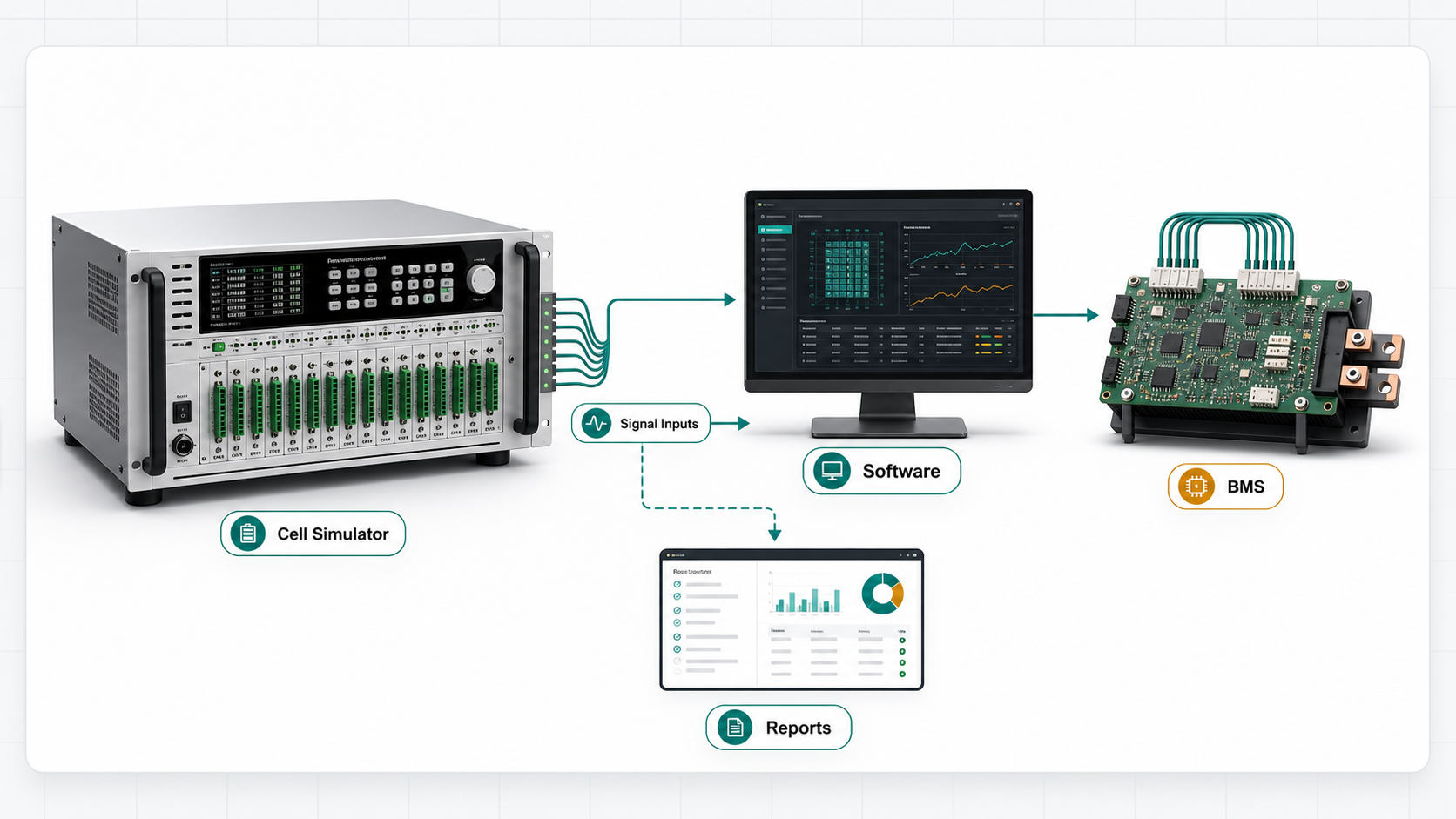
- Cell simulation plus signal validation
- Fault response and protection checks
- Automation, logs, and repeatable reports
Short answer: a BMS tester is the equipment set used to validate a battery management system. A practical BMS tester may combine a battery cell emulator, sensor and signal inputs, communication checks, fault injection, software automation, and reporting. It replaces real battery cells with controlled electrical signals so that BMS sensing, balancing, protection, and communication logic can be verified safely, repeatedly, and at scale before any live battery is connected.
Equipment scope
What a BMS Tester Includes
A complete BMS tester is more than a single instrument. It is a bench or system that covers the full validation path from cell-level inputs to pack-level reporting.
Validates temperature, current, relay, CAN, SMBus, and other signals required by the BMS. Signal inputs may be analog or digital depending on the BMS architecture.
Runs repeatable tests, records pass/fail data, and supports engineering handoff. Automated sequences reduce human error and ensure consistent coverage across test runs.
| Component | Purpose | Typical Range |
|---|---|---|
| Cell simulator channels | Provide programmable cell voltages to BMS sensing inputs | 12 to 36+ channels per unit; 0–6 V per channel |
| Pack voltage source | Supply total pack voltage for BMS power and measurement | 0–800 V depending on pack configuration |
| Temperature signal inputs | Simulate NTC thermistor or RTD signals | -40 °C to +85 °C equivalent |
| Current sensor input | Feed current shunt or Hall sensor signals | 0–1000 A range |
| Communication interface | Monitor CAN, SMBus, UART, or ISO SPI traffic | Protocol-specific |
| Load or charger path | Simulate charge/discharge current through the BMS | Bidirectional, current-dependent |
Integrated platform option: the FT9350 comprehensive battery emulator combines cell and pack signals, up to 36 NTC temperature channels, total voltage/current signals, and controlled battery fault simulation in one modular 4U chassis.
Comparison
BMS Tester vs Battery Simulator
The terms are often used interchangeably, but they refer to different scopes of equipment. Understanding the distinction helps when selecting the right tool for your validation workflow.
| Item | BMS tester | Battery simulator |
|---|---|---|
| Scope | Complete BMS validation bench or equipment set. | Battery-like source, cell emulator, or pack simulator used inside the bench. |
| Focus | Sensing, balancing, protection, communication, fault response, and reporting. | Controlled battery voltage, current, cell states, or pack behavior. |
| Includes | Cell simulator, signal inputs, communication monitoring, software, and reporting. | Typically voltage/current channels only, without signal or communication validation. |
| Best query | Use when selecting a complete test system. | Use when selecting the battery emulation hardware. |
In practice, most BMS tester setups rely on one or more battery simulators as the core cell emulation component. Read the battery emulator vs battery simulator comparison for more detail on these hardware categories.
Validation
Typical BMS Tests
BMS testers are used across multiple validation stages. Below are the most common test categories, from basic sensing to fault response.
Check cell thresholds, calibration, and boundary detection. Verify that the BMS correctly reads each cell voltage within specification tolerance.
Validate active or passive balancing behavior and timing. Confirm that the BMS initiates and terminates balancing at the correct voltage thresholds.
Repeat open, short, overvoltage, undervoltage, and communication fault cases. Verify that protection responses occur within specified time limits.
Detailed Test Sequence Examples
| Test | Method | Pass Criteria |
|---|---|---|
| Cell voltage accuracy | Set each simulator channel to known voltage; compare BMS reading. | BMS reading within ±5 mV of set value. |
| Over-voltage protection | Ramp cell voltage above OV threshold; observe BMS response. | BMS opens contactor within specified time (e.g., <100 ms). |
| Under-voltage protection | Lower cell voltage below UV threshold; observe BMS response. | BMS opens contactor and logs fault code. |
| Cell imbalance detection | Set one channel 200 mV below others; check BMS alert. | BMS flags imbalance and initiates balancing or warning. |
| Open wire detection | Disconnect one cell channel; observe BMS response. | BMS detects open wire within defined scan period. |
| Short circuit protection | Simulate short condition on cell input; observe BMS response. | BMS opens contactor within <10 ms. |
| Temperature protection | Set NTC signal above over-temperature threshold; observe BMS. | BMS reduces current or opens contactor per thermal model. |
| Communication loss | Interrupt CAN bus; observe BMS fallback behavior. | BMS enters safe state within specified timeout. |
Standards
BMS Testing Standards and Regulations
BMS testing is guided by industry and regulatory standards that define safety, performance, and reliability requirements for battery systems.
| Standard | Scope | Relevance to BMS Testing |
|---|---|---|
| ISO 26262 | Automotive functional safety | Defines ASIL levels and verification requirements for BMS hardware and software. |
| IEC 62619 | Industrial lithium batteries | Requires BMS protection against overcharge, overcurrent, and thermal runaway. |
| UL 2580 | EV battery safety | Specifies BMS protection tests including short circuit, overcharge, and crash safety. |
| GB/T 38031 | Chinese EV battery safety | Covers thermal runaway propagation, BMS response, and safety warning requirements. |
| UN 38.3 | Battery transport safety | Requires short circuit, overcharge, and forced discharge tests that affect BMS design. |
| SAE J2464 | EV battery abuse testing | Defines mechanical, thermal, and electrical abuse tests relevant to BMS validation. |
Compliance with these standards often requires documented test results, automated pass/fail reporting, and repeatable test sequences. A BMS tester with software automation and data logging simplifies compliance workflows and reduces the risk of gaps in test coverage.
Development stages
BMS Tester Use Across the Product Lifecycle
BMS testers serve different purposes at different stages of the product lifecycle. The equipment requirements and test emphasis change as the product matures from early prototyping to mass production.
| Stage | Primary Goal | Typical Tester Configuration |
|---|---|---|
| R&D prototyping | Verify BMS algorithms, sensing accuracy, and protection logic. | Few channels (6–12), manual control, flexible scripting. Focus on cell simulation and fault injection. |
| Design validation (DVT) | Prove design meets specifications and standards. | Full channel count matching BMS, automated test sequences, data logging. Fault injection and boundary testing. |
| Production validation (PVT) | Validate production processes and yield. | Multiple benches, high throughput, automated pass/fail. Integration with MES or quality systems. |
| Manufacturing test | Detect defects on the production line. | Fast test cycles (<60 s), simplified fault set, barcode tracking, yield reporting. |
Selection checklist
Questions Before Choosing a BMS Tester
Selecting the right BMS tester depends on your specific BMS architecture, test requirements, and team workflow. Use this checklist to narrow down the options.
- How many cell channels must the BMS monitor?
- What voltage range per channel is needed (e.g., 0–5 V for LFP, 0–4.5 V for NMC)?
- Which faults must be automated rather than tested manually?
- Do sensor, relay, CAN, or current signals need to be validated in the same bench?
- Will the tester be used for engineering development, production validation, or both?
- What reports and data logs are required for engineering handoff or compliance documentation?
- Does the BMS use active or passive balancing, and does the tester need to simulate balance current?
- What communication protocols does the BMS use (CAN, SMBus, ISO SPI, UART)?
- Is remote control or automation via SCPI, Modbus, or API required?
- What safety interlocks or emergency stop features are needed for the test environment?
FAQ
BMS Tester FAQ
What is a BMS tester?
It is a test bench or equipment set for validating battery management system functions before and during pack integration. A BMS tester typically includes cell simulation, signal inputs, communication monitoring, fault injection, software automation, and reporting.
Is a battery simulator enough for BMS testing?
It is often a core part, but a complete BMS tester may also need signal inputs, communication checks, load paths, software automation, and reporting. A battery simulator provides cell voltages; a BMS tester validates the full system response.
What standards apply to BMS testing?
Common standards include ISO 26262 for automotive functional safety, IEC 62619 for industrial lithium batteries, UL 2580 for EV battery safety, and GB/T 38031 for Chinese EV battery safety. Each defines specific protection and validation requirements that the BMS tester must be able to exercise and document.
Can a BMS tester automate fault injection?
Yes. Modern BMS testers support automated fault sequences including open circuit, short circuit, over-voltage, under-voltage, and communication loss. This allows protection responses to be validated repeatedly without manual intervention, which is essential for compliance testing and production validation.
What is the difference between R&D and production BMS testers?
R&D testers prioritize flexibility, scripting, and deep fault analysis. Production testers prioritize speed, throughput, automated pass/fail, and integration with manufacturing systems. Some platforms can serve both stages with different software configurations.
Which page should I read next?
Read BMS simulation if you are comparing software models, hardware emulation, and real battery validation stages. Read battery cell emulator if you want to understand the cell-level hardware in more detail.
Talk to FaithTech
Need a BMS tester or complete validation bench?
Share your BMS architecture, channel count, signals, fault cases, and automation plan. FaithTech engineers can help configure the right test bench for your validation requirements.