
Use a battery cell simulator when the BMS must see individual cell voltages, imbalance, and channel-level fault cases. Multi-channel emulation accelerates development by letting engineers step through fault conditions in minutes rather than hours. For more detail, see battery cell simulators.
Terminology guide
Battery Emulator vs Battery Simulator
Battery emulator and battery simulator are often used for similar equipment, but engineers should compare them by test purpose, signal level, channel count, fault simulation, and whether real battery testing is still required.
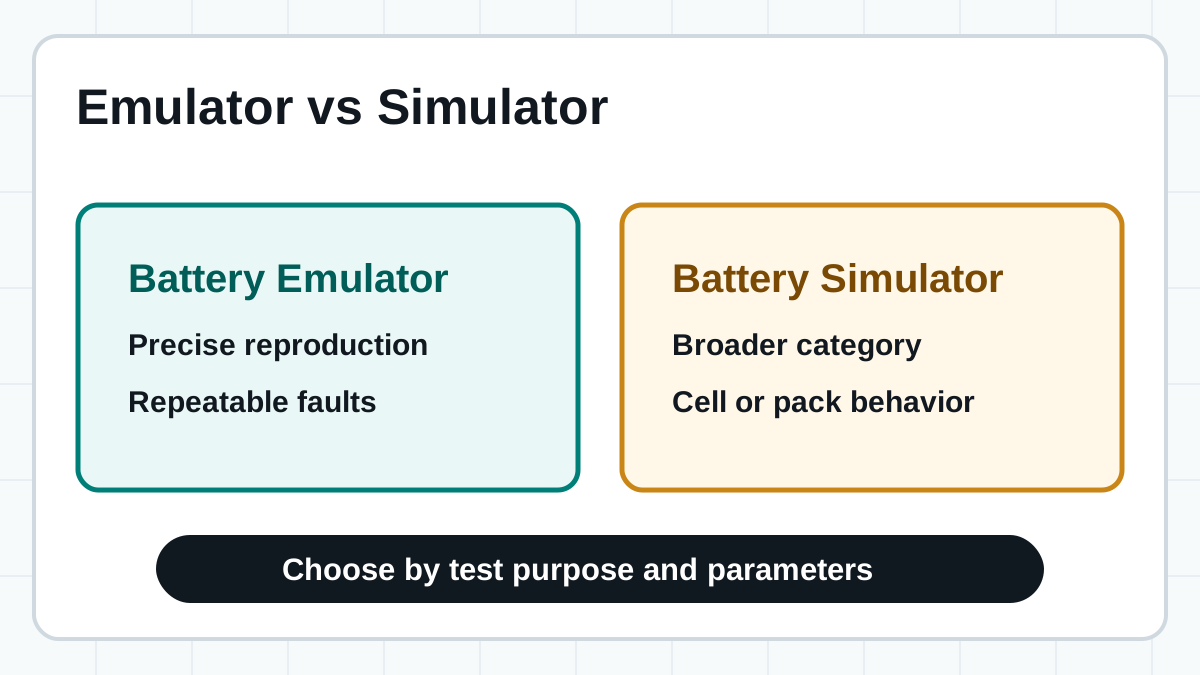
- Battery emulator: precise programmable reproduction
- Battery simulator: broader equipment category
- Battery cycler: real battery charge and discharge testing
Short answer: in many BMS projects, the terms battery emulator and battery simulator overlap. Instead of choosing by name alone, define what the system must reproduce. If you need individual cell monitoring and balancing checks, check out our guide on battery cell simulators. If you need high-voltage system testing, see battery pack simulators. To compare actual laboratory configurations, check out battery simulator test equipment. For a deeper look at underlying architectures, read about battery emulator circuits.
Definitions
What Emulator and Simulator Mean in Battery Testing
In electronics test engineering, emulation generally means replacing a physical component with a programmable instrument that reproduces its terminal behavior with high fidelity. A battery emulator therefore implies a device that presents electrical characteristics equivalent to a real battery: open-circuit voltage, internal resistance, state-of-charge-dependent voltage curves, current response, and fault conditions such as open wire, short, and over-voltage.
Simulation is a broader concept. A battery simulator can mean a hardware instrument, a software model running on a real-time processor, or a combined hardware-in-the-loop (HIL) system. Because the scope is wider, the term battery simulator does not automatically guarantee the same channel density, voltage accuracy, or fault injection capability that a dedicated emulator offers. When evaluating equipment, engineers should look past the label and verify specifications such as voltage resolution, current sink and source capability, isolation between channels, and the speed at which the unit can transition between states.
Why the Distinction Matters for BMS Engineers
A BMS measures cell voltages, temperatures, and sometimes impedances to make safety and balancing decisions. If the test equipment cannot reproduce millivolt-level differences or inject specific fault sequences, the BMS validation coverage is incomplete. Emulator hardware is typically optimized for this exact use case: repeatable, high-resolution, multi-channel output with programmable faults. Simulator hardware may be optimized for higher-level system tests where exact cell-level fidelity is less critical than pack-level voltage and current behavior.
Terminology in Supplier Documentation
Suppliers sometimes use emulator and simulator interchangeably in datasheets. One vendor may call a 24-channel cell-voltage source a simulator, while another calls a functionally identical unit an emulator. The key is to map your test requirements to the instrument's electrical specifications rather than relying on the product name. Review channel count, voltage and current range, settling time, communication interfaces, and software automation support before deciding.
Industry usage
How the Industry Uses These Terms
Across the battery test industry, emulator and simulator overlap significantly, but there are observable patterns in how different teams apply the terms.
Automotive and HIL teams often prefer emulator when referring to hardware that replaces the battery in a hardware-in-the-loop rig. The emphasis is on real-time electrical behavior and deterministic response. Battery management system developers may use cell simulator or cell emulator to describe multi-channel voltage sources that replicate individual cells in a series string. System integration and charger test teams sometimes use simulator to describe a single high-power source that presents pack-level voltage and current, without the need for per-channel granularity.
Academic and research environments may use simulator to refer to software-based battery models, while emulator is reserved for the physical power hardware that executes those models. In production test environments, the distinction is less important than throughput, channel density, and automated fault coverage. For a broader introduction to the underlying concepts, see battery simulator fundamentals.
Direct comparison
Battery Emulator vs Simulator vs Cycler
The following table summarizes how each term is typically used, what it is best suited for, and where it should not be used as the sole validation method. Understanding these boundaries helps teams build a test strategy that combines emulation for speed with real battery testing for safety confidence.
| Term | What it usually means | Best for | Not ideal for |
|---|---|---|---|
| Battery emulator | Programmable equipment that reproduces battery behavior with precision. | BMS logic, fault testing, repeatable boundary cases. | Final real battery safety validation. |
| Battery simulator | Broad category for equipment that acts like a battery during tests. | General electronics, BMS, pack behavior, lab benches. | When the term is not specified by electrical details. |
| Battery cell simulator | Multi-channel equipment that reproduces individual cell voltages. | Cell-string BMS sensing, balancing, and protection checks. | Whole-pack thermal or abuse testing. |
| Battery cycler | Equipment that charges and discharges real cells or packs. | Capacity, cycle life, aging, and performance data. | Fast early BMS fault simulation without real batteries. |
By application
Comparison by Application
Choosing between an emulator and a simulator depends heavily on the application. The required channel density, power level, and fault complexity vary across BMS testing, charger validation, hardware-in-the-loop integration, and cycling workflows.
BMS Testing
For BMS development, a battery cell emulator or simulator must provide individual cell voltage outputs, temperature sensor emulation, and fault injection. The FT8330 series, for example, is designed to replicate cell strings with high accuracy so that sensing, balancing, and protection algorithms can be validated without constructing a physical battery pack for every test iteration. BMS testing benefits from repeatable fault sequences: open-wire detection, over-voltage, under-voltage, and imbalanced strings. These are difficult and dangerous to create with real cells but straightforward with an emulator.
Charger Testing
Charger testing typically focuses on pack-level voltage and current. A single-channel battery simulator or emulator that can sink and source current is often sufficient. The goal is to verify that the charger correctly detects pack presence, negotiates charge current, terminates at the correct voltage, and responds to faults. For this application, the distinction between emulator and simulator is less critical than the power rating and the ability to replicate pack impedance and state-of-charge curves.
Hardware-in-the-Loop (HIL)
HIL systems integrate real-time simulation software with power hardware. In this context, the term emulator is common because the hardware must reproduce battery terminal behavior in real time based on a dynamic model. Latency, bandwidth, and deterministic response matter more than in static bench tests. If you are building or expanding a HIL rig, verify that the emulator's communication latency and voltage update rates match your real-time target requirements.
Battery Cycling and Aging
Cycling is not emulation. A battery cycler performs real charge and discharge cycles to measure capacity fade, internal resistance growth, and thermal behavior over hundreds or thousands of cycles. Emulators and simulators cannot replace cyclers for chemistry-specific aging studies. However, cyclers are slow and expensive for early-stage electronics validation, which is why most labs use both: emulators for control logic and fault testing, cyclers for chemistry validation and final certification.
Decision path
Which One Should a BMS Team Choose?
Selection should be driven by the test target, not by terminology. The following cards summarize the most common decision points based on whether your project requires cell-level granularity, pack-level power, or final safety validation with real cells.
Use pack-level simulation when a controller or system needs pack voltage, current, and state behavior. This applies to charger tests, inverter tests, and system-level integration where individual cell granularity is unnecessary. See battery pack simulators for pack-level options.
Use real packs and safety systems for final validation after simulation has reduced early risk. Real batteries reveal chemistry-specific behaviors, thermal interactions, and mechanical issues that no emulator can fully replicate.
Cyclers in context
How Battery Cyclers Fit into the Terminology
Battery cyclers occupy a distinct place in the test equipment landscape. While emulators and simulators reproduce electrical behavior, cyclers interact with physical electrochemistry. They apply charge and discharge currents to real cells, measure capacity, track efficiency, and generate the aging data needed for state-of-health estimation algorithms.
Cyclers are essential for:
- Capacity verification and grading of production cells
- Cycle life and calendar aging studies
- Thermal characterization under real load profiles
- Safety abuse testing such as overcharge and external short
- Generating parameter sets for battery models used in emulators
Because cyclers operate on real cells, they are slower, more expensive per test, and require safety infrastructure such as thermal chambers and gas detection. Emulators and simulators complement cyclers by handling the fast, repeatable electronics validation that would be impractical with real batteries. A well-structured lab workflow runs BMS software validation on an emulator, then transitions to real cells on a cycler for performance confirmation and safety certification.
FaithTech mapping
How the Terms Map to FaithTech Paths
FaithTech organizes its battery test portfolio by application depth rather than by strict terminology. The following mapping shows how emulator, simulator, and real-battery needs align with specific product families.
Cell simulation and BMS validation workflows with voltage and fault options. These units are used for cell-string emulation, sensing verification, and automated fault injection in BMS development.
Bidirectional behavior, balancing checks, and automated BMS benches. Suitable for tests that require current flow in both directions, such as regenerative braking simulation or active balancing validation.
For projects that move beyond emulation into real battery safety testing, including cycling, thermal abuse, and overcharge verification required for certification.
Selection checklist
Decision Checklist for Selecting the Right Tool
Use this checklist to decide whether your project needs a battery emulator, a broader battery simulator, or a combination that includes cyclers and safety systems.
- Define the test target. Are you validating a BMS, a charger, an inverter, or a full system? BMS work usually needs multi-channel cell emulation; charger and inverter work often needs pack-level simulation.
- Count the channels. A 16S or 24S battery string needs at least that many independent voltage outputs. Verify that the equipment supports the series count and voltage per channel your design requires.
- Specify voltage and current range. Confirm that the emulator covers your cell chemistry's nominal and maximum voltages, and that it can sink or source the balancing and load currents your BMS expects.
- Check fault injection. Can the unit simulate open wire, short, over-voltage, under-voltage, and communication faults? Automated fault sequences save significant test time.
- Assess isolation. Channels must be isolated to stack in series safely. Verify isolation voltage ratings match your pack voltage.
- Evaluate automation. Does the instrument offer SCPI, CAN, or software APIs that integrate into your existing test framework? Automation is critical for regression testing.
- Plan for real battery validation. Identify which tests must still run on real cells or packs, and ensure your schedule includes cycler or safety test time for final certification.
FAQ
Battery Emulator vs Battery Simulator FAQ
Are battery emulator and battery simulator the same?
They often overlap, especially in BMS testing. The exact meaning depends on supplier, project stage, and electrical requirements. Emulators usually emphasize precise programmable reproduction, while simulators cover a broader range of battery replacement equipment and software models.
Which term is better for Google searches?
Both matter. Engineers search for battery emulator, battery simulator, battery cell simulator, and battery simulator test equipment depending on their project stage. Search behavior is split across these terms, so technical documentation should reference the vocabulary its audience uses.
What should I specify instead of relying on the name?
Specify channel count, voltage range, current range, isolation, accuracy, fault cases, balancing needs, and automation workflow. The name alone does not guarantee that the equipment matches your BMS architecture or test protocol.
Does simulation remove the need for battery cyclers?
No. Simulation helps validate electronics earlier, while cyclers and safety systems are still needed for real battery performance and safety data. Emulators accelerate development; cyclers provide the ground truth for chemistry behavior.
When should I choose a battery emulator over a simulator?
Choose a battery emulator when your test requires precise voltage and current reproduction, fast dynamic response, repeatable fault injection, and integration with HIL or automated BMS test benches. Choose a broader battery simulator when the requirement is less specific or when the term is used loosely to describe any battery replacement source. For automated BMS benches with per-channel fault injection, emulator-class hardware is usually the better fit.
How do battery cyclers fit into emulator and simulator terminology?
Battery cyclers are a separate category. They perform real charge and discharge cycles on physical cells to gather capacity, aging, and performance data. Emulators and simulators replicate electrical behavior without a real battery, making them faster for control logic and fault testing, but they cannot replace cycler-based validation for chemistry-specific aging or safety certification. Most professional labs use both: emulators for speed, cyclers for final validation.
Related guides
Read the Specific Topic Next
Talk to FaithTech
Not sure which term matches your project?
Send your test target, voltage range, channel count, fault cases, and validation stage. FaithTech engineers can map the right simulator, emulator, or real battery test path.